
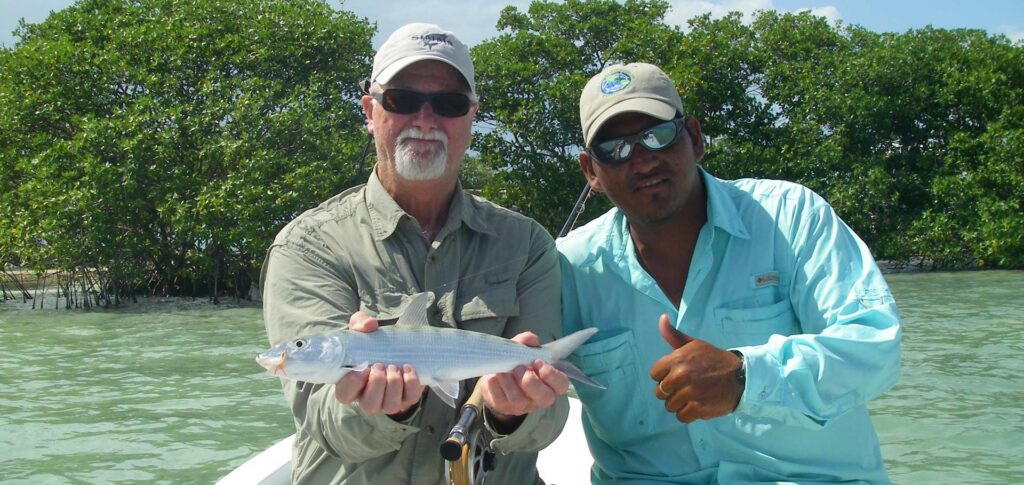
You Fly Fish Trout—Here’s What Changes When You Come to Belize
If you have spent years fishing rivers in Colorado, Montana or Pennsylvania, you already know how to cast, manage line and read water. Those are real skills, and they give you a useful foundation for Belize.
But the first time you stand on a flats boat near San Pedro, several things will feel unfamiliar. The fish are moving, the wind matters more, the equipment is heavier and your guide may spot the fish well before you can see it.
Knowing what changes before your trip can help you spend less time fighting old habits and more time making useful casts.
If this will also be your first charter from Ambergris Caye, start with First Time Fishing in San Pedro: Here’s What to Actually Expect. It covers equipment, licences, weather, pickup and other practical details.
The hardest trout habit to break: lifting the rod
A trout angler’s instinct is to lift the rod when a fish takes the fly. On the flats, that reaction can pull the fly away before the hook is properly set.
For bonefish and permit, the usual response is a firm strip-set:
- Keep the rod pointed low.
- Remove slack from the line.
- Pull firmly with your line hand.
- Allow the rod to come into play after the fish is connected.
Tarpon also require a strong strip-set, although fighting and landing one involves additional instruction. Listen to your guide because the correct response can depend on the fish, its position and what is happening at that moment.
Expect the old trout-set instinct to appear under pressure. That does not mean you have failed. It means you are replacing a deeply learned reaction with a new one.
Trout often hold in feeding lanes; flats fish keep moving
A trout may hold in a current seam, behind a rock or along a bank. If your first presentation misses, you may have another opportunity at the same fish.
Bonefish, permit and tarpon on the flats are often moving while feeding or searching for food. By the time you see the fish, it may already be changing direction or moving out of range.
You may only receive one good opportunity before the fish moves or becomes alarmed. That changes what a successful cast looks like.
The goal is not always the prettiest loop. It is delivering the fly:
- Quickly
- Accurately
- With limited false casting
- At the correct distance
- In front of a moving fish
- Without dropping the line across its path
Your guide may use clock directions—such as “bonefish at eleven o’clock”—along with an estimated distance. Practising this communication before the first serious opportunity can prevent confusion.
You must learn to see fish differently
On a trout stream, you may look for a rise, a shadow, a feeding lane or the flash of a fish holding beneath the surface.
On Belizean flats, you may be looking for:
- A moving shadow
- A change in colour
- A tail breaking the surface
- Nervous water
- A wake
- A brief flash
- Movement over sand, grass or broken bottom
At first, your guide may see nearly every fish before you do. That is normal. Guides spend years learning how light, bottom colour and water movement reveal a fish.
Good polarized sunglasses help. Brown, copper and amber lenses are often useful on the flats because they reduce glare while maintaining contrast.
When your guide points out a fish, do not be embarrassed if you cannot see it immediately. Keep the rod ready, follow the directions and ask for another reference point.
Wind becomes part of nearly every cast
Many trout anglers are accustomed to using current to help with presentation. On an open flat, there may be no bank, trees or valley walls to shelter you.
Wind affects:
- Casting distance
- Loop control
- Accuracy
- Line speed
- How quickly the fly reaches the fish
- Whether the guide can pole and position the boat effectively
A 40-foot accurate cast delivered quickly can be more valuable than a much longer cast that requires several false casts and lands off target.
Before travelling, practise casting in the wind from different directions. Work on your double-haul, but also practise picking up the line and making a useful cast without excessive preparation.
Saltwater equipment feels heavier because it is
A typical trout angler may be comfortable with a 4- or 5-weight rod. Belizean flats fishing commonly requires heavier saltwater equipment suited to larger flies, stronger fish and windy conditions.
The heavier rod may feel awkward during your first few casts. The line, leader and fly can also behave differently from a light freshwater setup.
Captain Nato provides equipment based on the trip and target species, so you do not necessarily need to purchase an entire saltwater outfit for your first visit. Confirm what is included before travelling, especially if you prefer to use your own equipment.
If you bring your own gear, ask about:
- Appropriate rod weight
- Floating line
- Leader and tippet
- Recommended flies
- Reel capacity and backing
- Corrosion-resistant equipment
- Cleaning salt from your equipment after the trip
Line management matters before the fish takes
Saltwater fly fishing can involve a surprising amount of loose line around your feet. That line can catch on footwear, boat fittings, equipment or itself just as a fish begins to run.
Before casting:
- Keep the deck as clear as possible.
- Follow the guide’s instructions about where to stand.
- Organize the loose line.
- Avoid stepping on it.
- Check that nothing is wrapped around your feet.
- Be prepared to clear the line smoothly after the hook-up.
A good cast and hook-set can still be lost if the line catches before it reaches the reel.
Permit, bonefish and tarpon are different challenges
The three species associated with a Belize Grand Slam should not be treated as interchangeable.
Bonefish
Bonefish can provide an excellent introduction to flats fishing. They still demand good presentation and line control, but groups of feeding fish may offer an angler more than one opportunity.
Permit
Permit are famously difficult. Seeing one does not mean it will eat, and making a good cast does not guarantee a take. A day with credible permit opportunities can still be a meaningful fishing day even without landing one.
Tarpon
Tarpon require a firm hook-set and careful line management. Their jumps and power introduce another set of challenges after the fish is connected.
An Inshore Grand Slam—catching a bonefish, permit and tarpon in one day—is an aspiration, not a reasonable promise from any guide. In Belize, all three are protected catch-and-release species.
Your trout skills still give you a foundation
You are not starting over.
Trout fishing has already taught you:
- How to load a fly rod
- How to manage line
- How to make adjustments after a poor cast
- How to follow the behaviour of a fish
- How to stay patient
- How to listen to changing water conditions
- How to release fish carefully
What changes is the environment. You are learning different timing, a different hook-set and a different way of seeing fish.
Some anglers make the adjustment quickly. Others need time. The useful measure of a first Belize flats trip is not whether you immediately perform like a lifelong saltwater angler. It is whether you receive real opportunities, understand your mistakes and improve throughout the day.
What Captain Nato’s reviews reveal
Captain Nato’s customer reviews repeatedly mention instruction and adaptation—not only catching fish.
One experienced fly and light-tackle angler described landing a first bonefish after Nato found feeding fish in quieter water during difficult, overcast conditions. Another guest said Nato helped improve his fly cast and praised his knowledge of the local environment and fish behaviour.
A separate reviewer arrived with rusty saltwater fly-casting technique. According to the review, Nato helped get the angler’s double-haul working again and located several schools of bonefish despite rain and wind.
These accounts matter because they describe what a freshwater angler needs from a first saltwater guide:
- Clear instruction
- Patience
- Honest feedback
- Knowledge of alternative fishing areas
- Help correcting technique
- A willingness to adapt to the conditions
Reviews do not guarantee that another guest will catch the same fish or experience the same conditions. They do, however, provide evidence of Nato’s approach to guiding.
When should a trout angler visit Belize?
Fishing opportunities exist throughout the year, but seasonal patterns, weather, wind and water conditions can influence which species and techniques make the most sense.
Review the San Pedro fishing calendar before selecting your dates. It provides a month-by-month planning overview for bonefish, permit, tarpon and reef species.
Treat the calendar as guidance—not a prediction. Fish behaviour, tides and daily weather cannot be guaranteed.
If you have a priority species, tell Captain Nato before booking. It may affect the recommended month, trip duration and fishing area.
How to prepare before your trip
You do not need to become an expert saltwater angler before arriving. A little targeted practice will make the day easier.
Practise:
- Strip-setting while keeping the rod low
- Casting an 8- or 9-weight rod if available
- Making accurate 30- to 50-foot casts
- Casting into the wind
- Picking up and recasting quickly
- Double-hauling
- Limiting false casts
- Casting from different directions
- Responding to clock-position instructions
Bring polarized sunglasses and sun protection. Confirm whether equipment, licences, food and drinks are included. Most importantly, tell the guide the truth about your experience and what you hope to accomplish.
Choose the trip that matches your goals
A half-day can introduce you to the equipment, boat and basic techniques. A full day provides more time to adjust, explore different water and recover from missed opportunities or changing conditions.
Think about what you actually want:
- Your first bonefish
- Casting instruction
- A chance at permit
- Tarpon opportunities
- A mixed fly-and-spin trip
- A relaxed introduction rather than a high-pressure target
- A serious full-day Grand Slam attempt
There is no need to present yourself as more experienced than you are. Accurate expectations help Nato plan a better trip.
Ready to bring your trout skills to Belize?
Start by reading First Time Fishing in San Pedro: Here’s What to Actually Expect, then review the San Pedro fishing calendar for the month you are considering.
When you contact Captain Nato’s Charters, include:
- Your preferred dates
- Your freshwater fly-fishing experience
- Any previous saltwater experience
- Your target species
- Whether you prefer a half or full day
- The number of anglers
- Where you are staying on Ambergris Caye
Book a fly-fishing trip with Captain Nato’s Charters and let an experienced local guide help you make the transition from trout streams to Belizean flats.